
Whole School Programmes
S.P.E.A.K.
Speaking for Personal Empowerment and Articulation of Knowledge. Our whole-school oracy framework, built for Telugu-speaking learners of English as an Additional Language.
The promise
Every child finds their voice — in two languages.
Most oracy frameworks assume children already speak English fluently. Ours doesn’t. S.P.E.A.K. starts with EAL foundations, layers on Voice 21’s skills framework, and gives every child authentic reasons to speak.
The architecture
Three strands. One programme.
Each strand answers a different question — and together they cover all 140 teaching points across the primary years.
EAL Foundations
What our children need before oracy instruction can land. Listening comprehension, phonological awareness, formulaic chunks, academic language (CALP), translanguaging — 8 sub-skills, taught across 5 stages from immersion to autonomous transfer.
Learning to Speak
How to speak well. Voice 21’s Oracy Framework — 14 sub-skills across Physical, Linguistic, Cognitive, and Social-Emotional strands — adapted explicitly for EAL learners. Modeled → Drilled → Guided → Collaborative → Applied.
Speaking to Communicate
Why and where to speak. Three Voices — Thinking, Personal, Public — carry six authentic purposes across five speaking modes. The Voices of Cosmos student-voice routines (Voice Circles, Forums, Co-Design Teams) are where this lands for real — children practise oracy in conversations that genuinely shape the school.
The Three Voices
Every child has three voices.
Each Voice gives purpose to talk, and each comes in two flavours. Children practise all six across every subject, every assembly, every conversation in the corridor.
Thinking Voice
The talk that drives cognitive growth — half-formed and tentative on purpose.
Explore
Hypothesise, wonder, reason aloud.
Inquire
Ask, probe, investigate.
Personal Voice
The talk that makes a community — identity, relationships, belonging.
Share
Present knowledge and experiences.
Connect
Greet, encourage, support.
Public Voice
The talk that moves people — beyond the classroom, into the world. Practised at scale through the Cosmos Orators Club, House Forums, and Student Council, where what children say genuinely shapes what the school does.
Influence
Persuade, advocate, debate.
Entertain
Perform, recite, captivate.
Voice 21 · the four skill strands
Fourteen skills, every child, every year.
Adopted from the Voice 21 framework (developed in partnership with Cambridge), with EAL-specific adaptations. Each skill spirals across Key Stages — same skill, deeper expectation.
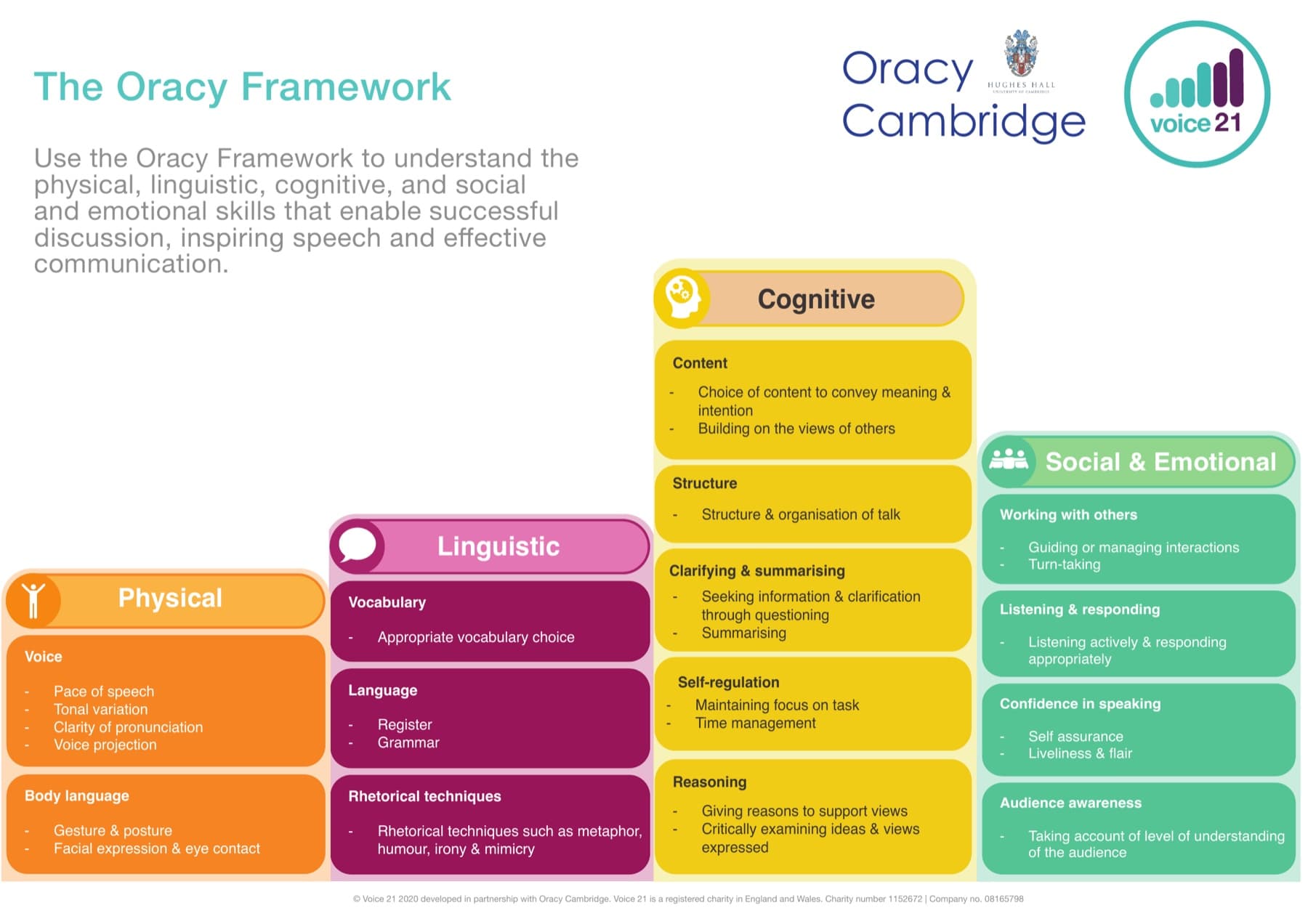
Physical
How a child’s body and voice show up in talk. The volume of an EY3 reading aloud at the morning meeting; the steady pace of a Grade 4 hot-seating a character from a story; the eye contact a Grade 6 makes when presenting a project to parents. We teach English stress and intonation explicitly, because they differ from the rhythms of Telugu.
Linguistic
The words children pull from when they want to say what they mean. From the precise verb a Grade 2 picks to describe a tadpole, to the connectives — “however”, “consequently”, “as a result” — a Grade 6 reaches for in a debate. Word Wizards builds vocabulary in concentric rings (concrete, then academic, then figurative); Morpheme Mavericks teaches how words are built from roots and affixes; Colourful Semantics gives every child a way to construct full sentences before they have to write them.
Cognitive
The thinking that talk reveals. A Grade 3 summarising what their group decided. A Grade 5 reasoning out loud about why two characters in a story disagree. The half-formed, exploratory talk that lets a child grow an idea before it has to be neat. Sentence stems and discourse markers give every child a way in.
Social-Emotional
The relational side of talk. A Grade 1 child taking a turn instead of interrupting. A Grade 4 child disagreeing politely. A Grade 6 child reading the room before launching into a story. Cultural norms around eye contact, turn-taking, and challenging an idea are taught — not assumed — because they differ across our home languages.
How children learn to speak
Five practice modes, in order.
Every Voice 21 skill is taught through the same five-mode progression — from teacher modelling to independent application.
Modeled
Teacher demonstrates with think-alouds. Children observe and analyse expert examples.
Drilled
Repeated practice of specific features — choral repetition, pronunciation, phrase practice. Especially important for EAL phonology.
Guided
Scaffolded practice with teacher coaching. Fishbowl discussions, supported presentations.
Collaborative
Peer practice using structured protocols — talk partners, group discussion, collaborative tasks.
Applied
Independent use in authentic, meaningful contexts — real presentations, real debates, real conversations.
The 12 oracy units
Twelve units, four Key Stages, one playful arc.
Each unit has a Role that stays constant across the school (Explorers, Storytellers, Debaters…) and a playful name that changes by Key Stage to mark the deepening expectation. Six units a year on a two-year spiral, so every child experiences all twelve before moving up a Key Stage.
Thinking Voice
— 4 units- T1
Explorers
Wondering, hypothesising, "what if" talk, generating ideas.
Early Years
Little Wonderers
KS1
Wonder Wanderers
Lower KS2
Idea Adventurers
Upper KS2
Hypothesis Hunters
Little Wonderers
Wonder Wanderers
Idea Adventurers
Hypothesis Hunters
- T2
Questioners
Asking good questions, interviews, curiosity, seeking information.
Early Years
Asking Friends
KS1
Curious Cats
Lower KS2
Question Questers
Upper KS2
Interview Experts
Asking Friends
Curious Cats
Question Questers
Interview Experts
- T3
Reasoners
Thinking aloud, explaining reasoning, metacognition, making thinking visible.
Early Years
Thinking Buddies
KS1
Brain Sharers
Lower KS2
Logic Builders
Upper KS2
Metacognition Masters
Thinking Buddies
Brain Sharers
Logic Builders
Metacognition Masters
- T4
Investigators
Talk for learning, group inquiry, problem-solving dialogue, collaborative investigation.
Early Years
Puzzle Pals
KS1
Learning Detectives
Lower KS2
Problem Crackers
Upper KS2
Inquiry Champions
Puzzle Pals
Learning Detectives
Problem Crackers
Inquiry Champions
Personal Voice
— 4 units- P1
Presenters
Show & tell, presentations, explaining knowledge, demonstrating.
Early Years
Show & Tell Friends
KS1
Spotlight Stars
Lower KS2
Knowledge Sharers
Upper KS2
Expert Explainers
Show & Tell Friends
Spotlight Stars
Knowledge Sharers
Expert Explainers
- P2
Storytellers
Personal narratives, building on stories, anecdotes, narrative sharing.
Early Years
Story Friends
KS1
Tale Spinners
Lower KS2
Narrative Builders
Upper KS2
Story Weavers
Story Friends
Tale Spinners
Narrative Builders
Story Weavers
- P3
Befrienders
Friendship talk, empathy, emotional support, social bonding.
Early Years
Kindness Pals
KS1
Friendship Builders
Lower KS2
Empathy Experts
Upper KS2
Relationship Champions
Kindness Pals
Friendship Builders
Empathy Experts
Relationship Champions
- P4
Spotlighters
Hosting, introducing, putting spotlight on others, welcoming, MC skills.
Early Years
Hello Helpers
KS1
Guest Greeters
Lower KS2
Hospitality Heroes
Upper KS2
Master of Ceremonies
Hello Helpers
Guest Greeters
Hospitality Heroes
Master of Ceremonies
Public Voice
— 4 units- U1
Advocates
Persuasive speeches, expressing opinions, taking a stand, campaigning.
Early Years
Voice Finders
KS1
Opinion Sharers
Lower KS2
Persuasion Pioneers
Upper KS2
Changemakers
Voice Finders
Opinion Sharers
Persuasion Pioneers
Changemakers
- U2
Debaters
Discussion, responding to opposing views, argumentation, negotiation.
Early Years
Agree & Disagree Friends
KS1
Discussion Starters
Lower KS2
Argument Builders
Upper KS2
Critical Challengers
Agree & Disagree Friends
Discussion Starters
Argument Builders
Critical Challengers
- U3
Performers
Drama, recitation, improvisation, captivating audiences, entertainment.
Early Years
Little Stars
KS1
Stage Sparklers
Lower KS2
Drama Makers
Upper KS2
Captivating Artists
Little Stars
Stage Sparklers
Drama Makers
Captivating Artists
- U4
Speechmakers
Special-occasion speeches, toasts, tributes, ceremonial speaking.
Early Years
Party Talkers
KS1
Celebration Speakers
Lower KS2
Special Moment Makers
Upper KS2
Tribute Masters
Party Talkers
Celebration Speakers
Special Moment Makers
Tribute Masters
Naming convention: [Voice]: [Role] — [Playful Extension]. Children grow up with the same Role from EY1 to Grade 6 — Wonder Wanderers become Idea Adventurers become Hypothesis Hunters — so they feel the arc of their own progression in the words they hear.
From practice to participation
Where children use these voices for real.
S.P.E.A.K. teaches the skills. Voices of Cosmos is where children spend those skills — Pulse Surveys, Voice Circles, Forums, Co-Design Teams, and Student-Led Action — saying things that genuinely shape what the school does.