
Cambridge Pathway · Stage 1 of 4
Cambridge Early Years.
A child-centred, play-based programme for ages 3–6. Children develop at their own pace across six curriculum areas, building the foundations for everything that comes next.
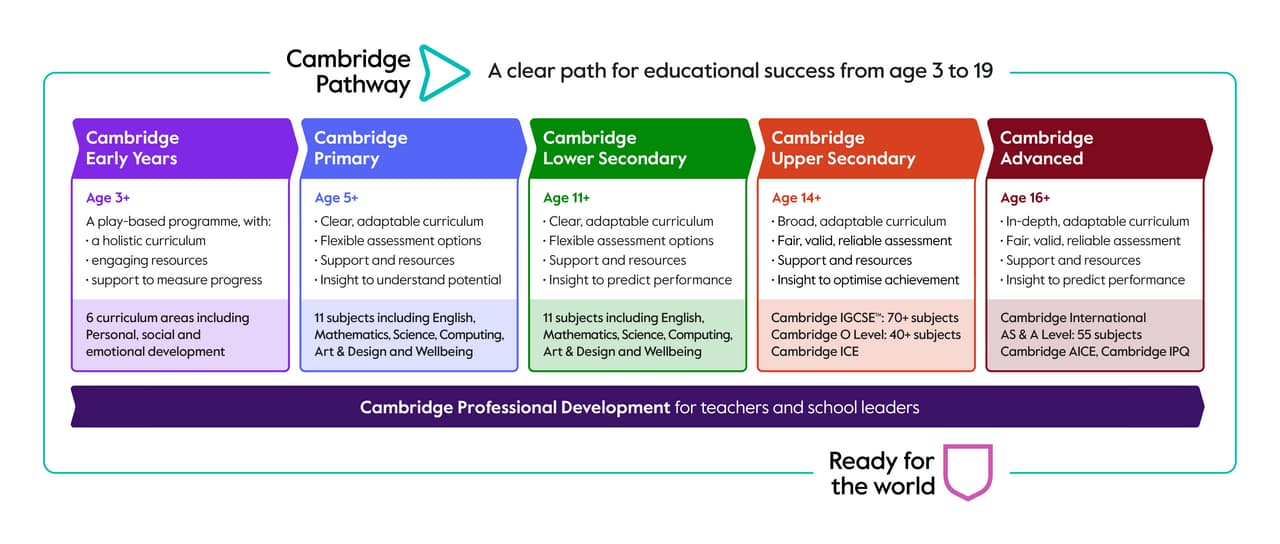
Cambridge Early Years is the first stage of the Cambridge Pathway, designed to give young learners the best start in life. It is research-informed and built around six curriculum areas that work together — no single area is ranked above another, because at this age every domain of development depends on the others.
The Cambridge approach is child-centred and play-based. It supports learners at varying English proficiency levels, accommodates bilingual and multilingual classrooms, and helps every child meet key early developmental milestones.
The Cambridge framework
Six curriculum areas.
These are the official Cambridge Early Years curriculum areas. We teach all six, every day.
Communication and literacy
Speaking, listening, reading and writing. The foundations of early communication, in English alongside the home language.
Mathematics
Mathematical language, thinking and concepts. Number, shape, pattern, and the mathematical habits of mind.
Personal, social and emotional development
Central to children’s lives, underpinning wellbeing. Identity, relationships, self-regulation, and care for self and others.
Physical development
Gross-motor and fine-motor skills developed through play. Coordination, balance, dexterity, and a healthy relationship with the body.
Creative expression
Art, design, music, dance and drama. Children make meaning by creating, performing, and responding to the work of others.
Understanding the world
Children’s natural curiosity is the engine. Exploration of the natural, made, and human worlds — the seed of every later humanity and science.
At Cosmos
How we run Early Years.
Three year groups, each with its own home, mascot, and rhythm. The same Cambridge framework, scaled to where the child is.
EY1
First year
Ages 2½–3½. Settling-in routines, oral language, rhyme and song, free play with adult-modelled extensions, and the first daily A.I.M. circle.
EY2
Middle year
Ages 3½–4½. Cambridge Phonics begins. Number sense to 10. Daily Discovery Block exploring the natural and made worlds. Personal, social and emotional development through the S.T.A.R. expectations.
EY3
Bridging year
Ages 4½–5½. Phonics secure for early reading; emerging writing. Number to 20 and early addition. Sustained group projects in the Discovery Block. Independent self-regulation through A.I.M.
Wrapped around Cambridge
Whole School Programmes that support Early Years.
Cambridge sets the framework. Our Whole School Programmes give it the daily routines, materials, and shared language that make it land in EY1, EY2, and EY3.
Communication and literacy
R.E.A.D.
Daily story time, a 100 Book Challenge in EY3, the Learnarium book corner from EY1 onward, and Cambridge Phonics from EY2. Reading begins as listening and grows into independence.
Programme detailCommunication and literacy
S.P.E.A.K.
Oracy from day one. EAL Foundations for Telugu- and Hindi-speaking learners, daily talk routines, and the three Voices (Thinking, Personal, Public) introduced through play and song.
Programme detailCommunication and literacy · Physical development
Write Right
Pre-writing patterns in EY1, letter formation in EY2, and the first independent sentences in EY3. Handwriting taught alongside fine-motor play, never separate from it.
Programme detailPersonal, social and emotional development
L.I.F.E.
Our PSHE programme, paired with the daily A.I.M. routine (Acknowledge · Identify · Make a choice). The S.T.A.R. expectations are introduced gently in EY1 and become second nature by EY3.
Programme detail
A day in Early Years · the block model
What an Early Years day looks like.
The same campus-wide bell schedule, scaled to where the child is. EY1 finishes earlier; EY2 and EY3 sit through the full day. Every day weaves through Cambridge’s six curriculum areas.
Early Years (EY1, EY2, EY3)
Ages 2–5
- 8:30– 8:45Morning Meeting
L.I.F.E (PBIS/SEL) — greetings, attendance, an SEL micro-routine, the day’s intention. Teacher 1 leads; Teacher 2 models and supports regulation.
- 8:45– 9:00Curriculum Routines
Sound Wall · Math Working Wall · Language Wall (EY2 / EY3). EY1 moves straight into Numeracy.
- 9:00– 10:00Numeracy Block
Math Core via the M.A.S.T.E.R. routine — manipulatives at EY1, full 60-min concentration block at EY3.
- 10:00– 10:20Break
Snack, hygiene, transition routines. Teachers model social skills.
- 10:20– 12:10Literacy Block
R.E.A.D → English Core (Cambridge) → Write Right / S.P.E.A.K. T1 instructs phonics; T2 runs guided groups. The longest sustained learning window of the day.
- 12:10– 12:50Lunch
Communal lunch with shared mealtime routines.
- 12:50– 1:20Provisions
Snack, stretching, regulation routines.
- 1:20– 1:50Discovery / Language
Understanding the World; language modelling and small-group work.
- 1:50– 2:30Enrichment
C.R.E.A.T.E. arts (Music continuous, with Visual Arts / Theatre / Dance / Media Arts on rotation) and Computing — with daily MOVE alongside at EY3.
- 2:30– 2:50MOVE
Outdoor / movement block. Minimum two outdoor sessions across every EY day.
- 2:50– 3:00Closing Circle
Reflection prompts, recap of the day, and read-aloud.
Schedule shown is EY3. EY1 follows the same blocks with shorter durations and an early dismissal at 12:30 (lunch folded into morning Montessori). EY2 sits between — 100-min Literacy, full afternoon Montessori block.
Numeracy and Literacy occupy the 8:45–12:00 window across every stage.
Morning Meeting at 8:30 and Break at 10:00 are universal — enabling assemblies, cross-class collaboration, shared transitions.
L.I.F.E opens, Reflection closes — every day, every stage.
**Bilingual and multilingual.** Most of our families speak Telugu or Hindi at home. The Cambridge framework is explicitly designed for this — the home language is welcomed and used as a bridge to English, never as a deficit to overcome.
**Progress and milestones.** Cambridge Early Years measures progress against developmental milestones rather than test scores. Termly observations, photo-documented learning stories, and a parent-facing milestone report at the end of each stage are how families see their child grow.
Next step
After Early Years.
Children move into Cambridge Primary at Grade 1, continuing on the same Pathway with the same Cambridge frameworks for English, Mathematics, Science, and the Arts.