
Student voice
Voices of Cosmos.
Student voice is not merely collecting feedback. It is a redistribution of power.
The core proposition
Student voice, when done authentically, drives deeper engagement, improved teaching quality, and stronger school culture.
Three voices
Three questions every child can answer.
Every student-voice activity is framed through three culture areas. The voice tag sets the content; the routine sets the mechanism.
Heart — Wellbeing & Environment
How am I feeling here? Happiness, safety, belonging, friendships, spaces, facilities, comfort, lunch, playground.
Character — Culture & Relationships
How are we doing together? House life, events, assemblies, traditions, peer dynamics, behaviour expectations, community identity.
Mind — Curriculum & Teaching
How is my learning going? Subjects, whole-school programmes, topics, difficulty, relevance, explanations, pace, activities, resources.
Skills & Voices · two sides of the same coin
First we equip — then we listen.
The same three culture areas run in two directions. Our L.I.F.E. programme builds the daily skills (Mood Meter, S.T.A.R. Matrix, Meta-Meter, the A.I.M. routine) so children grow up with the language to give meaningful voice. Voices of Cosmos is the output side.
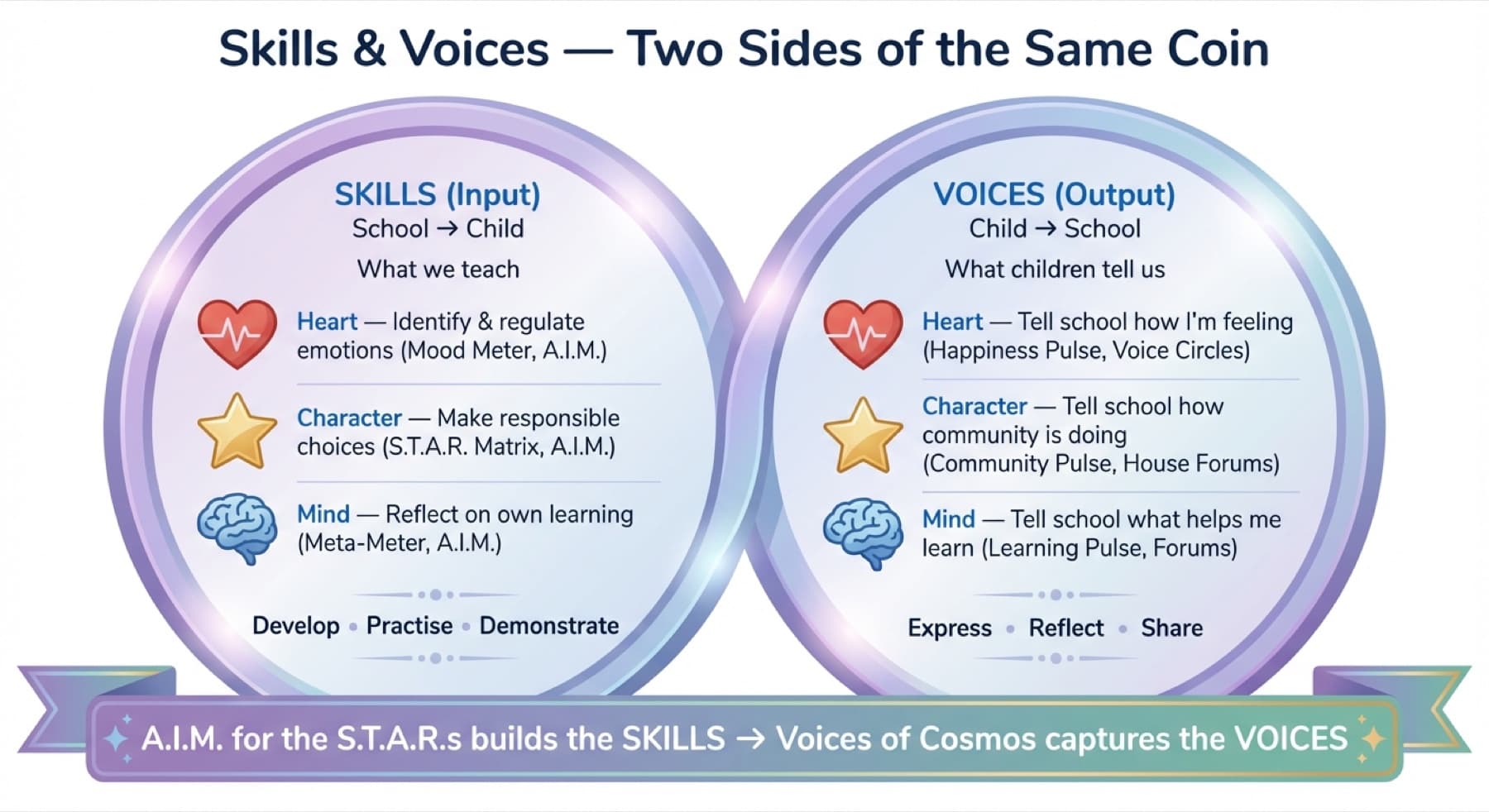
Heart
L.I.F.E. Skill
I can identify and regulate my emotions.
Mood Meter · A.I.M.
My Voice
I can tell the school how I’m feeling here.
Happiness Pulse · Voice Circles
Character
L.I.F.E. Skill
I can make responsible choices in my community.
S.T.A.R. Matrix · A.I.M.
My Voice
I can tell the school how our community is doing.
Community Pulse · House Forums
Mind
L.I.F.E. Skill
I can reflect on my own learning.
Meta-Meter · A.I.M.
My Voice
I can tell the school what helps me learn.
Learning Pulse · Forums
L.I.F.E. + the daily A.I.M. routine build the skills. Voices of Cosmos captures the voices. Same three areas — first we equip, then we listen.
The V.O.I.C.E. protocol
How we listen — together.
Every routine follows the same five-step protocol. Staff learn one process; children recognise one pattern. The "E" step is the anti-tokenism safeguard — we always close the loop.
Voice It
I share my ideas.
Organise It
We group what we said.
Interpret It
We check: did they hear us right?
Connect It
Our ideas go to the right people.
Evidence It
We find out what happened.
The Ladder
Five routines, five levels.
The Ladder of Student Participation is our architecture — five levels, each with a single routine type that flexes across all three voices.
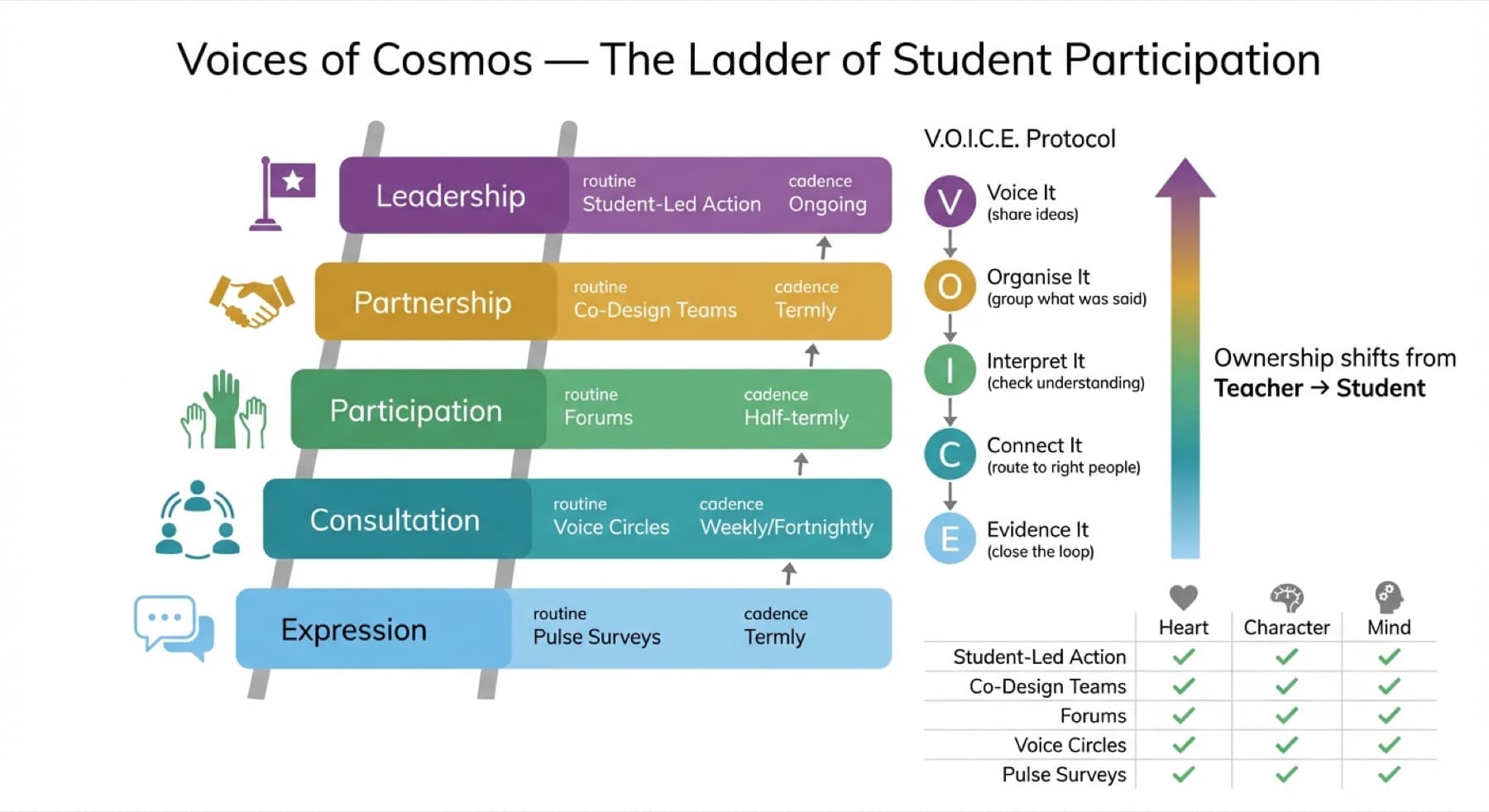
Pulse Surveys · Expression
Students share thoughts and feelings through structured instruments. Happiness Pulse (Heart), Community Pulse (Character), Learning Pulse (Mind) — termly.
Voice Circles · Consultation
Adults actively seek and deepen student input through weekly or fortnightly class discussions.
Forums · Participation
Students are involved in decision-making dialogue with adults — class forums, house forums, open forums with the SLT.
Co-Design Teams · Partnership
Students and adults co-design together — wellbeing initiatives, house events, lesson elements, Impact Team projects.
Student-Led Action · Leadership
Students lead initiatives independently — Wellbeing Champions, Cosmos Student Council, House Captains, Student Learning Walks.